When Your Halifax Commercial Floors Need a Full Strip and Wax
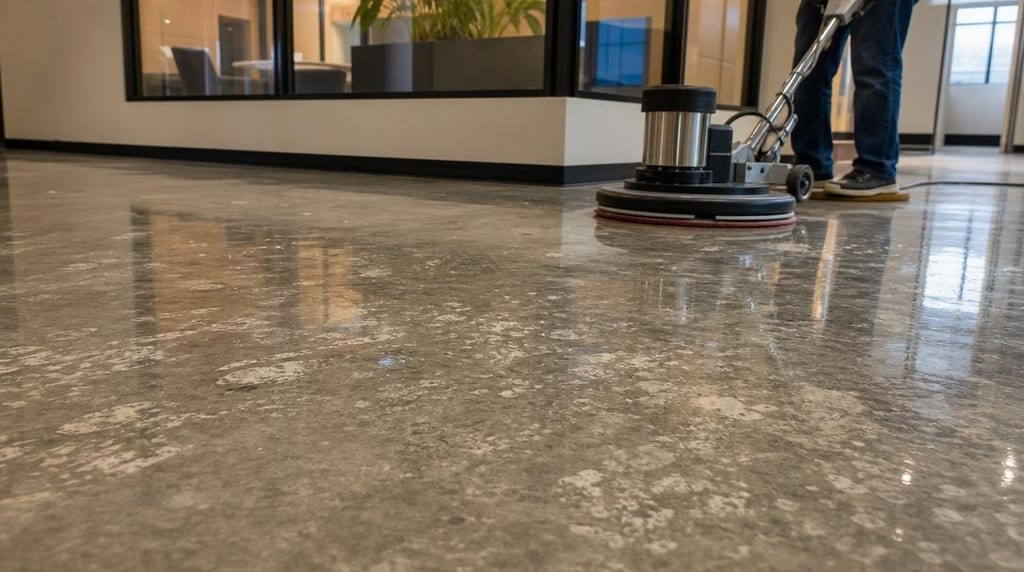
Halifax winters are rough on commercial floors, but the real damage shows up in April when the salt season ends and you finally see what’s underneath all those months of tracked-in grit and brine. You buff the floor, maybe do a scrub-and-recoat, and the shine still won’t come back.
The finish looks tired no matter what you do.
That’s the moment scrub-and-recoat isn’t enough anymore. A scrub-and-recoat adds fresh wax over existing layers, and it works well when the finish underneath is still sound. But when wax has built up for years, yellowed along the edges, or been ground down by heavy traffic, you’re layering new product over a compromised base. The floor looks worse each time.
The visual signs are hard to miss once you know what to look for. Yellowing that creeps in from the corners and baseboards. Black scuff trails through main walkways that won’t buff out. A finish that reflects overhead lights unevenly, with dull patches beside shinier sections. These aren’t cosmetic annoyances. They mean the existing wax has broken down past the point of recovery.
Halifax’s winters speed this up. Road salt and brine get tracked in from November through April, and salt crystals act like sandpaper on VCT. They grind through wax topcoats faster than floors in milder climates. That means commercial floor refinishing in Halifax often hits the strip-required threshold sooner than the property manager expects.
When those signs show up, a full strip is the reset the floor needs. If your floors are already showing those warning signs, give C & C Commercial Cleaning Services Inc a call at (902) 440-8694. We can typically sort out the scope in a single site visit before you book another coat of wax over a base that can’t hold it. The natural next question is how often that reset should happen.
How Often Should Commercial Floors Be Stripped and Waxed?
There’s no universal answer, but there are reliable benchmarks worth knowing.
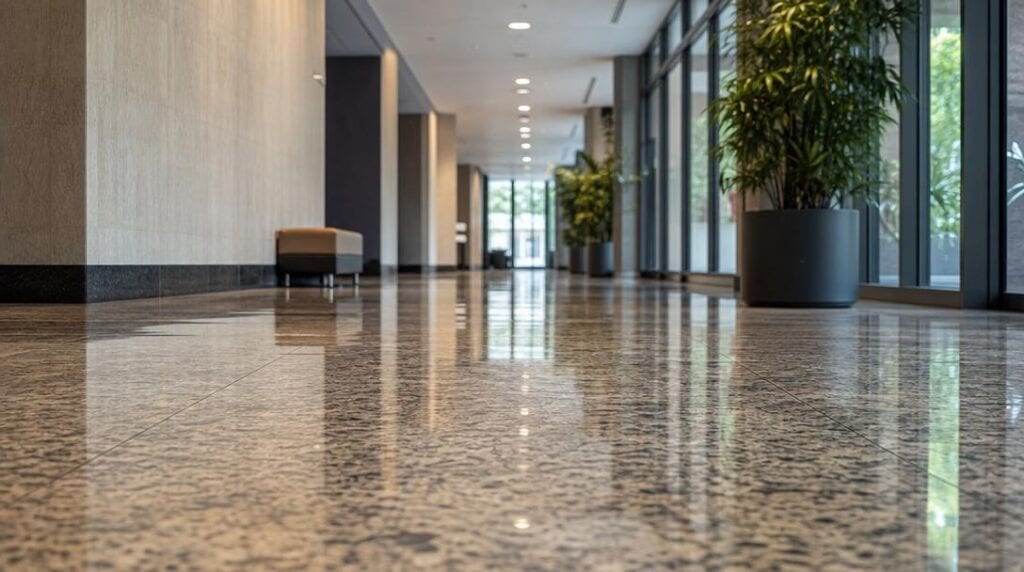
High-traffic Halifax spaces, retail stores, school hallways, and healthcare clinics, generally need a full strip and wax every four to six months. Lower-traffic offices can go a full year between full strips. The difference comes down to how often commercial floors should be stripped and waxed based on foot traffic, cleaning chemicals, and whatever gets tracked in from outside.
Salt season changes the math for ground-floor entrances and lobbies. From November through April, road brine and salt crystals get tracked across VCT daily. That kind of abrasive exposure chews through wax faster than normal wear. Many Halifax property managers find they’re looking at a full strip one to two months earlier than they otherwise would.
Between full strips, a scrub-and-recoat extends the floor’s life without starting from scratch. It removes the top layer of worn finish, adds fresh coats, and restores gloss. It’s the right call when the floor is dull and scuffed but the wax hasn’t broken down to the tile itself. Think of it as a tune-up between major services.
Once you know the schedule that makes sense for your building, the next piece is understanding what actually happens during the work itself.
The 5-Step Strip and Wax Process
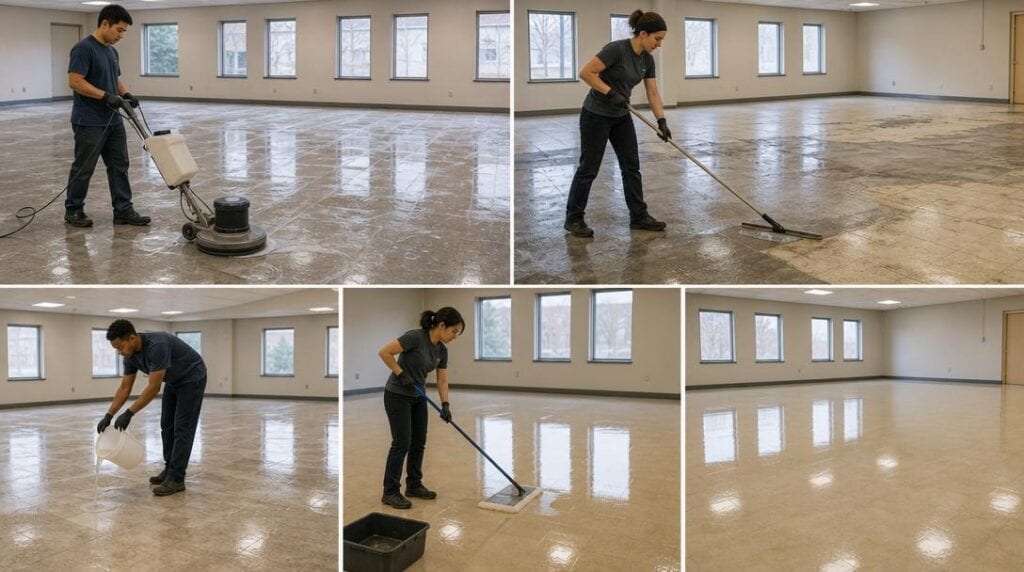
Here is what proper floor stripping services actually look like, from the moment the crew arrives to the final coat.
Step 1: Prep the space. Everything moveable comes off the floor first, chairs, mats, rolling carts, whatever is in the way. The crew dust mops the entire surface to clear loose grit and debris. Baseboards get masked so the stripper solution doesn’t stain them. This step takes longer than most property managers expect. Rushing prep is how you end up with a patchy result.
Step 2: Apply the stripper solution. A commercial-grade stripper gets applied across the floor and left to dwell. That dwell time is what actually softens and lifts the old wax buildup. Cut it short and the buffer has to work harder, and the old finish doesn’t come up cleanly.
Step 3: Agitate with a low-speed buffer. A low-speed machine fitted with a black stripping pad works the solution into the old finish layers. This is where yellowed wax buildup from years of coatings gets broken down and loosened from the VCT surface.
Step 4: Remove the slurry and rinse. A wet vac pulls up the dissolved wax and dirty solution. The floor then gets rinsed with clean water, sometimes twice, until the pH is neutral. Skipping the rinse is one of the most common shortcuts, and it stops the new finish from bonding correctly.
Step 5: Apply 3 to 5 coats of finish. Each coat goes down thin and gets a full dry cycle before the next one starts. In a climate-controlled building on a dry day, coats might cure in 30 to 45 minutes. In Halifax, coastal humidity pushes that closer to 60 minutes or more per coat. A five-coat finish on a humid April evening is a multi-hour commitment. That’s exactly why most Halifax jobs get scheduled overnight or over a weekend.
Each of those steps matters. Cut any one of them and the finish either doesn’t bond, doesn’t last, or both. If you want to see what a proper strip and wax looks like for your specific space before committing to anything, C & C Commercial Cleaning Services Inc can walk you through it during a site assessment.
Now that the process is clear, the obvious next question is how long the whole job takes.
How Long Does a Strip and Wax Take?

Planning around the work is half the battle.
A small commercial space, around 1,000 to 1,500 square feet, is typically a one-night job. The crew comes in after close, strips and cleans the floor, lays three to five coats of finish, and is out before the morning shift arrives.
Larger spaces change that math fast. A full school hallway, a big-box retail floor, or a multi-room medical clinic often needs a full weekend to do properly.
Halifax’s coastal humidity is the reason cure times stretch longer here than the product label suggests. In drier climates, each wax coat may set in 30 to 45 minutes. Here, plan on 60 minutes or more between coats. Rush that and you get cloudy, soft finish that scuffs within a week.
Most C & C Commercial Cleaning Services Inc strip and wax jobs are scheduled for Friday night through Sunday, or overnight midweek when a business can clear the space. Either way, the building is ready for normal foot traffic Monday morning.
Before booking, it’s worth confirming the floor actually needs this service. Some common Halifax commercial flooring types should never be waxed at all, and knowing the difference saves time and money on both sides.
Which Halifax Floors Need Strip and Wax (and Which Don’t)
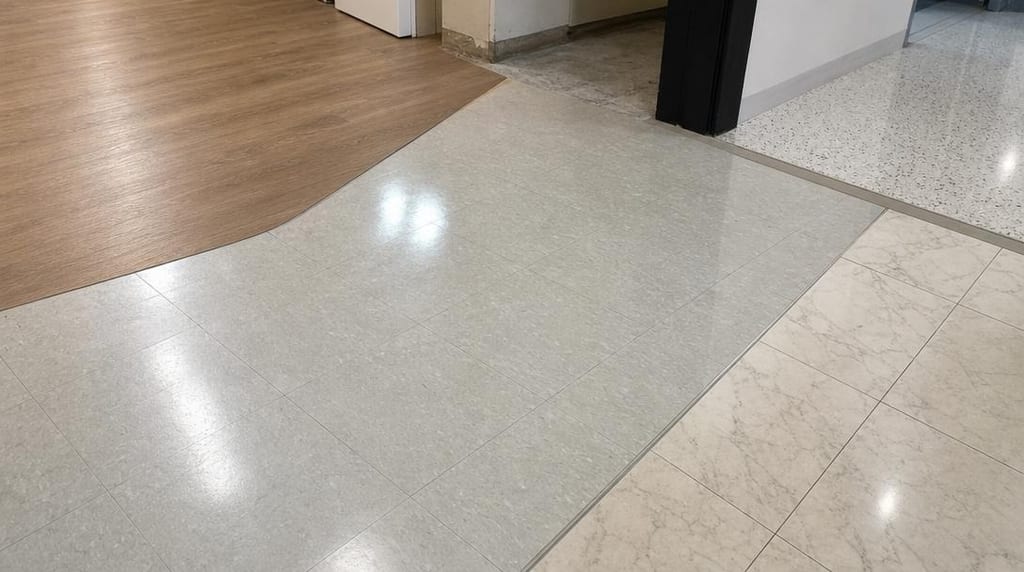
Not every hard floor is a wax floor. This trips up a lot of property managers, and it’s an easy thing to sort out before anyone wastes time on a site visit.
Strip and wax is designed for vinyl composition tile (VCT), older sheet vinyl, and certain linoleum floors. These materials are porous enough to hold a wax finish properly, and the finish is what protects them. Without it, they wear fast. Some of these floors also benefit from commercial floor buffing between full strips to extend the finish.
The floors that should never see wax: sealed concrete, luxury vinyl plank (LVT), ceramic tile, hardwood, and carpet. Wax on LVT doesn’t bond correctly and will peel. Hardwood and tile need entirely different maintenance programs. If you’re not sure what you have, call us at (902) 440-8694 or send a quick photo to our team before booking and save everyone a trip.
In Halifax, floor type usually comes down to when the building was built. Older downtown properties on Barrington Street and Spring Garden Road, along with historic Dartmouth buildings, were almost all tiled with VCT during the 70s and 80s. A lot of that original tile is still down there under decades of yellowed wax buildup. Those are full-strip jobs, not scrub-and-recoats.
Newer commercial builds in Bayers Lake and Burnside tend to go with LVT. Lower maintenance, but it requires a completely different cleaning approach.
Once you’ve confirmed your floor type, the next questions are usually about cost and timing.
Strip and Wax Pricing and Scheduling in Halifax
Cost is almost always the first real question after the floor type gets sorted out.
Strip and wax is priced per square foot, and the final number depends on a few things: the total area, how much wax buildup has to come off, how many finish coats the floor needs, and whether the work runs overnight or on weekends. After-hours jobs carry a surcharge. That’s standard across Halifax commercial cleaning contractors, and it reflects the reality of working around operating businesses.
C & C Commercial Cleaning Services Inc walks property managers through all of this during a site walkthrough before any numbers get finalized. Square footage alone doesn’t tell the full story. A 3,000-square-foot clinic with clean, well-maintained floors and a 3,000-square-foot school hallway that hasn’t been stripped since 2019 are two completely different jobs. For more on commercial cleaning pricing in Halifax, it’s worth understanding how scope and condition drive the final number.
On timing, April and May are the best months to book in Halifax. Salt season wraps up, tracked-in grit stops accumulating, and the new finish goes down on a clean surface. A floor refinished in spring has the best possible conditions to last through the following winter. It’s also easier to book. Summer and fall tend to fill up faster as property managers scramble before the cold comes back.
To request a walkthrough or get a quote started, use the contact form on the website and we’ll follow up within one business day. If you’d rather talk it through directly, the number is at the top of the page.
Getting the pricing right and locking in a good window are the practical parts. The next question is usually who’s actually doing the work.
Why Halifax Property Managers Call C & C Commercial Cleaning Services Inc

The work is only as good as the crew doing it.
C & C Commercial Cleaning Services Inc is WCB-NS registered and carries full commercial liability coverage, which matters when you’re signing off on a contractor working overnight in a building you’re responsible for.
The experience is local and specific. C & C Commercial Cleaning Services Inc has worked in downtown Halifax office towers, HRCE school hallways, medical and professional facilities in Bayers Lake and Burnside, North End restaurants, and Dartmouth retail properties. These aren’t similar jobs. Each environment has its own foot traffic patterns, floor conditions, and scheduling constraints, and the crew knows how to read them.
Every quote starts with a walkthrough. No phone estimates, no guesswork. A site visit means the scope is clear before the job starts, no surprises on the invoice, no corners cut because something wasn’t accounted for.
Strip and wax is also one piece of a broader floor program. Scrub-and-recoat, routine buffing, office cleaning, and ongoing janitorial maintenance are all available through the same contractor. For full-scope commercial cleaning services in Halifax, it’s the same crew across every visit.
If your Halifax building is running on VCT that hasn’t been stripped in years, the floor isn’t going to get better on its own. Call C & C Commercial Cleaning Services Inc at (902) 440-8694 and we’ll get a walkthrough scheduled.