
Commercial Waste Management in Halifax: The In-Facility Layer
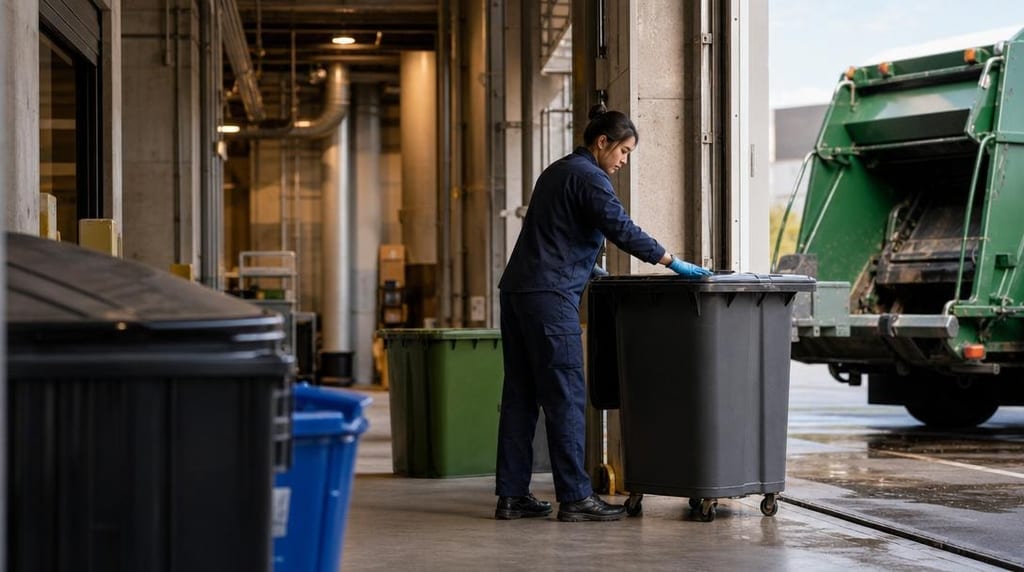
Every Halifax facility manager has the hauler figured out. What most of them are still working around is everything that happens inside the building before the truck arrives.
C & C Commercial Cleaning Services Inc handles the layer that comes before the truck. While GFL or HRM handles pickup at the curb, everything inside your building still needs to be managed. Daily. Bins emptied. Liners replaced. Streams sorted. Organics consolidated. Cardboard broken down. And all of it done to a standard that keeps your collection from getting rejected.
That standard, in Halifax, is Halifax By-law S-600. Every commercial property in the municipality is required to separate waste into four distinct streams: garbage, recycling, organics (green cart), and paper/cardboard. Miss a stream, cross-contaminate a bin, or leave organics in a recycling bag, and the hauler can refuse the entire load. The fine comes later. The mess is immediate.
This is in-facility waste management. It’s built directly into the janitorial contract with C & C Commercial Cleaning Services Inc, not managed separately, not treated as a line item. It’s handled during every scheduled clean as part of full commercial cleaning services in Halifax.
Most building managers are surprised at how much of waste management happens before the truck ever shows up. If that layer isn’t covered in your current janitorial contract, it’s worth a closer look at what’s actually moving through your back of house.
What’s Included in Commercial Waste Management (Our Scope)
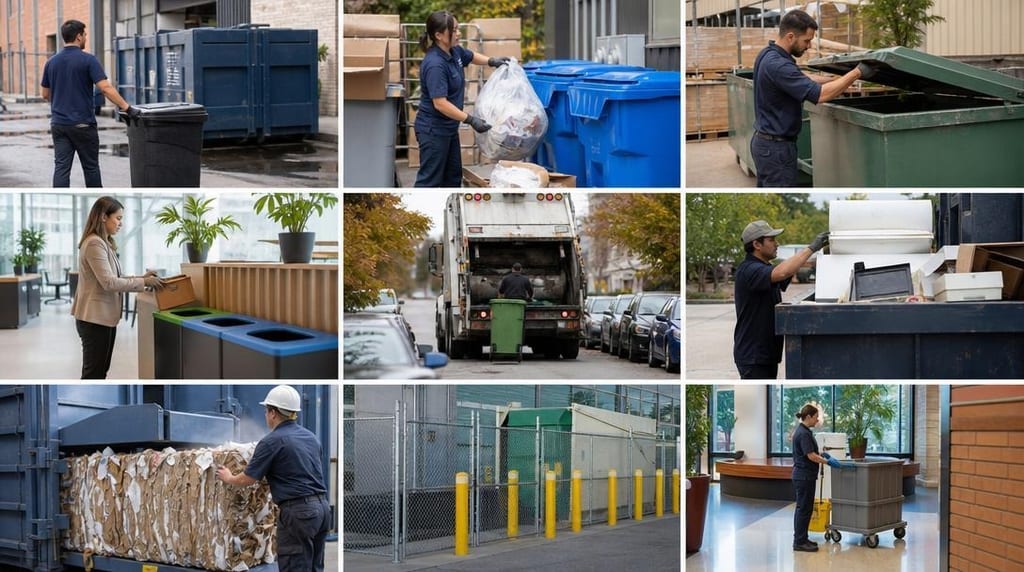
There’s a lot of ground between “we empty the trash” and what a Halifax commercial facility actually needs to stay compliant and functional. Here’s what C & C Commercial Cleaning Services Inc covers as part of the waste management scope.
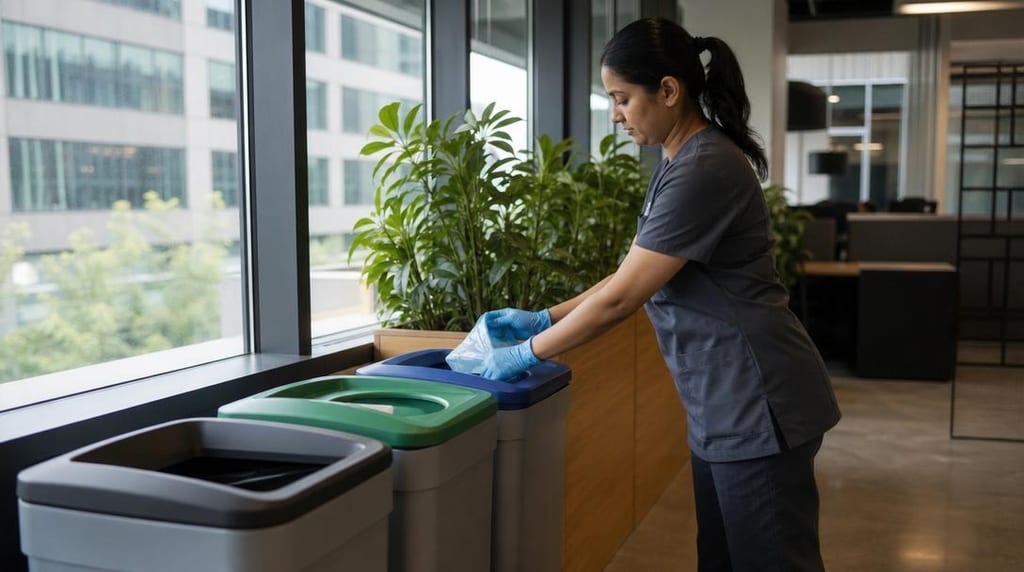
Bin emptying and liner replacement happen on a set rotation tied to your facility’s schedule, not whenever a bin happens to be full. Every collection point gets a fresh liner. That includes desk-side bins, breakroom stations, washrooms, and any shared-floor collection areas as part of the regular office cleaning round.
Four-stream sorting is done to Halifax By-law S-600 standards: garbage, recycling, organics, and paper/cardboard separated at every step. When a bin gets contaminated, HRM’s collection crews reject the whole stream at the curb. So our staff check for contamination before anything goes out, not after.
Cardboard breakdown and flattening. For Bayers Lake and Burnside tenants generating boxes daily, this is handled during the cleaning shift. Flattened cardboard is ready for collection without taking up half the loading bay.
Organics consolidation means kitchen and food-service bins get consolidated into the outdoor green cart at the end of each shift, a step restaurants and cafeterias need covered every day under Halifax’s municipal organics program.
Bin sanitization covers both interior and exterior wipe-down with deodorizing. In Halifax’s wet coastal climate, leachate and odour build up in waste areas fast. Maintenance, not optional.
Hazardous-adjacent items (sharps containers in medical or care settings, batteries, fluorescent tubes, expired cleaning chemicals) are flagged and coordinated through proper disposal channels. They never go into the regular stream.
Scope answers the first question facility managers usually ask. Frequency is almost always the second. If your current janitorial contract doesn’t address both, that gap is worth closing before the next collection day.
How Often Does Waste Need to Be Removed from a Halifax Facility?
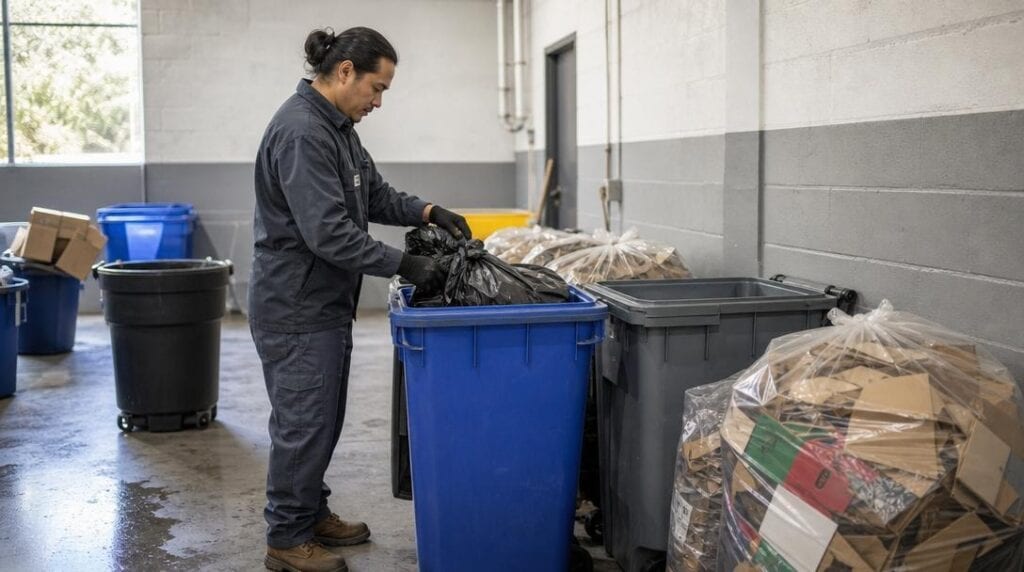
It depends on what your building does. But frequency matters more here than most clients expect.
For a typical Halifax office, that means emptying desk and kitchen bins nightly, replacing liners, and doing a full bin sanitization roughly once a week. That cadence works for low-volume environments where waste sits only a few days between HRM pickup windows.
Restaurants and food-service operations run on a tighter clock. Organics bins from kitchen prep and end-of-service need to be consolidated into the outdoor green cart every night without exception. Halifax’s coastal climate is unforgiving. Fog and warm wet air speed up odour and attract pests fast. A kitchen organics bin left unattended overnight in a Spring Garden or Barrington corridor space is a problem by morning.
Industrial facilities in Bayers Lake and Burnside generate a different kind of volume. Cardboard and pallet wrap accumulate through the day. Flattening and rotating those bins happens daily, sometimes more than once, not on a weekly schedule.
Downtown Halifax adds a coordination layer that other cities don’t have. When your building shares a back-alley collection point or loading bay with two or three other tenants, the janitorial crew managing your bins is also the one keeping those shared streams from getting mixed together before the truck arrives.
HRM’s curbside schedule doesn’t bend for a busy Friday. Internal bin rotation between pickups is what keeps operations running. Get the frequency right, and the next variable is contamination, which is where sorting discipline takes over.
Recycling, Organics, and By-law S-600: Keeping the Streams Clean

Halifax By-law S-600 isn’t a suggestion. Every commercial property, restaurant, and institution in HRM is required to separate four distinct streams: garbage, recycling, organics (green cart), and paper and cardboard. Get it wrong, and collection gets refused. The facility pays in rejected loads, in fines, and in the scramble to deal with a full bin that no one will touch.
HRM publishes sorting guides and provides labels for businesses. What they don’t provide is someone inside your building making sure the right material goes in the right container before it ever reaches the curb. That’s the gap. Enforcement happens at pickup, not before it. By the time a driver flags a contaminated bin, the damage is already done.
In downtown Halifax, along Barrington, Hollis, Spring Garden, back-alley collection points often serve multiple tenants at once. Bins are co-located, sometimes unlabelled, and contamination spreads fast. A single recycling bin with food waste in it pulls the entire stream. Trained janitorial staff sorting at the source is what keeps those shared collection areas functional.
Food-service tenants have an added layer. Halifax’s green cart organics program applies to commercial kitchens, and in most cases the janitorial crew at the end of a shift is the one consolidating kitchen organics into the outdoor cart before morning collection.
Nova Scotia’s Extended Producer Responsibility regulations, which came into effect December 1, 2025, have also shifted what goes in which stream. Most facilities are still working through what that means for their daily sorting. C & C Commercial Cleaning Services Inc keeps up with those changes so your staff doesn’t have to.
If contamination refusals have been a recurring problem at your building, call (902) 440-8694. That’s usually a sorting process issue we can identify quickly during a walkthrough.
Hauler vs. In-Facility Janitorial: Why Both Roles Exist
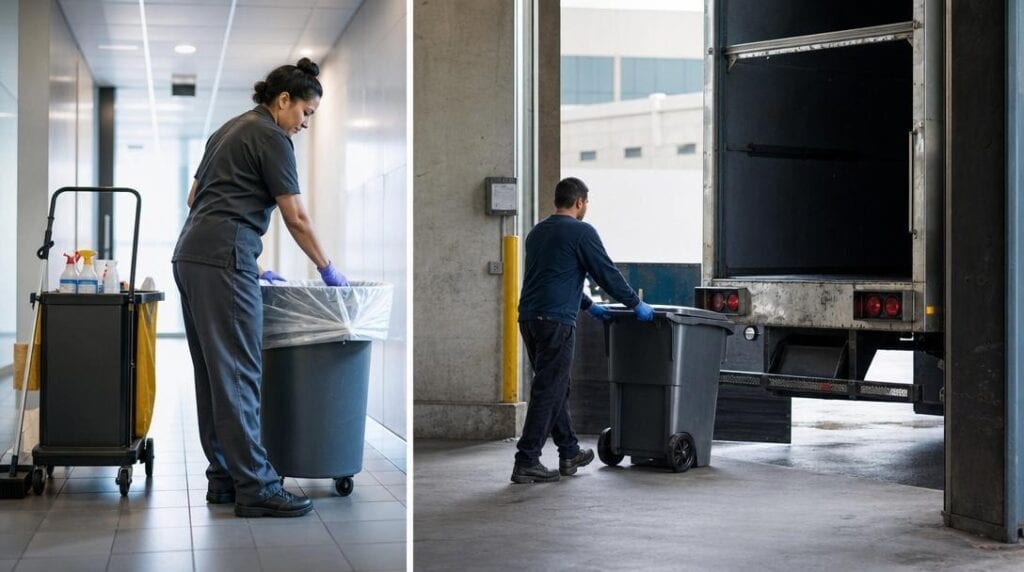
Two separate jobs have to happen before your waste leaves the building. Most Halifax facility managers only think about one of them.
GFL Environmental and HRM curbside collection handle the truck route, showing up on schedule, lifting the bin, hauling the load to the transfer station, billing for tipping fees and container rental. That’s their job. They’re not coming inside.
Everything inside the building is a different responsibility entirely. Who empties the bins between pickup days? Who keeps the four streams sorted to By-law S-600 standard so the collection crew doesn’t reject a contaminated load at the curb? Who flattens the cardboard, consolidates the organics into the outdoor green cart before close, wipes down the bin area, and swaps liners?
That’s in-facility waste management. It sits squarely in the janitorial scope.
C & C Commercial Cleaning Services Inc handles that layer. The work is built directly into the janitorial contract, no separate vendor, no second schedule to coordinate. The team works with whichever hauler the client already uses, whether that’s GFL, a private carrier, or HRM curbside, and keeps everything ready on their end.
What that looks like in practice varies by building type. An office tower on Barrington Street has different volume and stream demands than a restaurant on Agricola or a distribution facility in Burnside. The setup should reflect that.
Waste Management by Facility Type in Halifax

The building shapes the program. Here’s how that plays out across the facilities C & C Commercial Cleaning Services Inc regularly works in.
Downtown Halifax offices (Spring Garden, Barrington, Hollis) tend to share back-alley collection points where several tenants’ bins sit side by side. After-hours rotation and proper stream labelling by the cleaning crew is what keeps recycling from being contaminated before the hauler even arrives.
Bayers Lake, Burnside, and Dartmouth Crossing run heavier on cardboard and pallet wrap. In distribution and light-industrial units out here, flattening and consolidating cardboard is a daily job. Not something that waits until Friday. Sites coming off a build or fit-out also need post-construction cleanup coordinated with regular waste rotation so the loading bay clears in a sensible order.
Restaurants and food-service tenants operate under Halifax’s municipal green cart requirement. The nightly janitorial round, including dedicated food service area cleaning, is usually the one consolidating organics from kitchen bins into the outdoor green cart. Done right, it also keeps pest pressure down through the wet season.
Medical offices and labs generate sharps and biohazard-adjacent materials that need to be staged separately from general waste streams and flagged for the correct contracted disposal route. C & C Commercial Cleaning Services Inc coordinates the staging as part of medical office cleaning; the regulated pickup is handled by the appropriate licensed hauler.
Gyms, studios, and recreation centres produce high volumes of restroom and locker waste plus equipment-wipe disposables throughout the day, steady accumulation that needs mid-shift attention, not just an end-of-day sweep. That ties closely to restroom cleaning and sanitization on the same rotation.
Scoping a waste management program means accounting for all of this: volume, stream mix, frequency, and any regulated materials. That’s where pricing comes in.
How Waste Management Pricing Works in a Janitorial Contract
No two facilities price the same way, and that’s by design. Waste management scope within a janitorial contract is built around what your building actually generates: the number of waste stations, how many streams you’re separating to By-law S-600 standard, how often bins need emptying, whether sanitization is weekly or daily, and what volume of hazardous-adjacent materials (batteries, fluorescents) needs to be staged for specialty pickup.
A small Spring Garden office suite prices very differently from a Burnside warehouse running daily cardboard sort and organics consolidation. For a fuller picture of how commercial cleaning is priced in Halifax, we’ve broken that down separately, along with the difference between janitorial service and commercial cleaning and where waste management fits in either scope.
What most Halifax facilities find is that bundling waste management into the janitorial contract costs less than running it as a separate vendor line. One scope. One invoice. One point of accountability.
Before anything is signed, C & C Commercial Cleaning Services Inc walks the facility, maps the waste flow, and puts the full scope in writing. No estimates built on assumptions. No charges that appear after the fact. Call (902) 440-8694 to schedule that walkthrough, or use the contact form on this page if you’d rather send the details first and have us come prepared.
Why Halifax Businesses Hand Waste Management to C & C Commercial Cleaning Services Inc

Credentials matter more than claims. C & C Commercial Cleaning Services Inc has operated across HRM for years, serving clients in downtown Halifax, Bayers Lake, Burnside, Dartmouth, Dartmouth Crossing, and Bedford. Every crew member is trained on By-law S-600 sorting requirements and current on the EPR changes that came into effect December 1, 2025, the regulation shift most facilities are still working through.
Fully insured and bonded.
What clients notice most is the simplicity. Waste management folds into the existing janitorial contract. One invoice. One point of contact. Facilities across HRM have found that gap more expensive than expected, usually the first time a contaminated load gets refused and operations back up while the overflow sits. If your building is in Halifax, Dartmouth, Bedford, or Burnside and that’s a problem you’re working around, the walkthrough costs nothing. Call (902) 440-8694 and we’ll set it up.