CrossFit Studio Cleaning Built Around Your Class Schedule
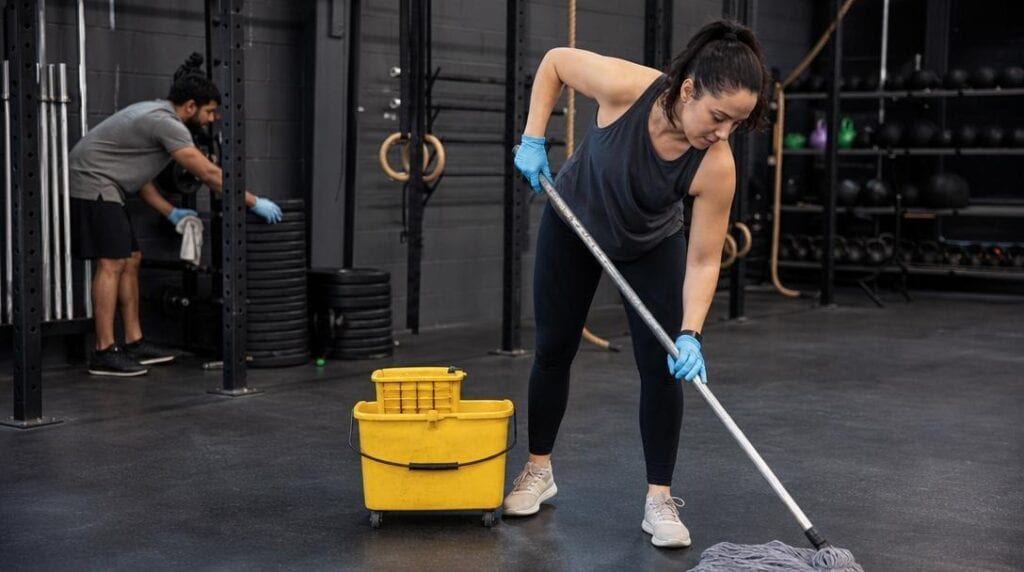
A CrossFit box in Halifax doesn’t get cleaned between sessions. It gets cleaned in spite of them.
Most Halifax boxes, whether they’re running out of Bayers Lake Business Park, Bedford along Hammonds Plains Road, or a converted unit in Burnside Industrial, operate from 6am straight through to a 7pm evening class. That leaves two real windows to work with: a mid-day lull between the morning and afternoon sessions, and an after-hours block once the last class clears out. Miss either window and you’re cleaning around members or pushing into the next morning’s open. This is the same operational reality we work with across gym and fitness center cleaning in Halifax, but a CrossFit box adds layers no standard fitness facility has to deal with.
C & C Commercial Cleaning Services Inc schedules around those windows by design. Before a single cleaner sets foot on the floor, the schedule is mapped to the box’s class timetable. No disruptions. No last-minute scrambles. No overlap with coaches or athletes. To talk through the timing before anything gets scheduled, call (902) 440-8694. We’ll map it to your timetable from the first conversation.
The piece most operators don’t plan for until it becomes a problem is chalk.
It gets into everything, and for most boxes in Halifax, it’s still being handled as a daily sweep-and-forget.
How We Handle Chalk Dust (Floors, Equipment, and Ventilation)
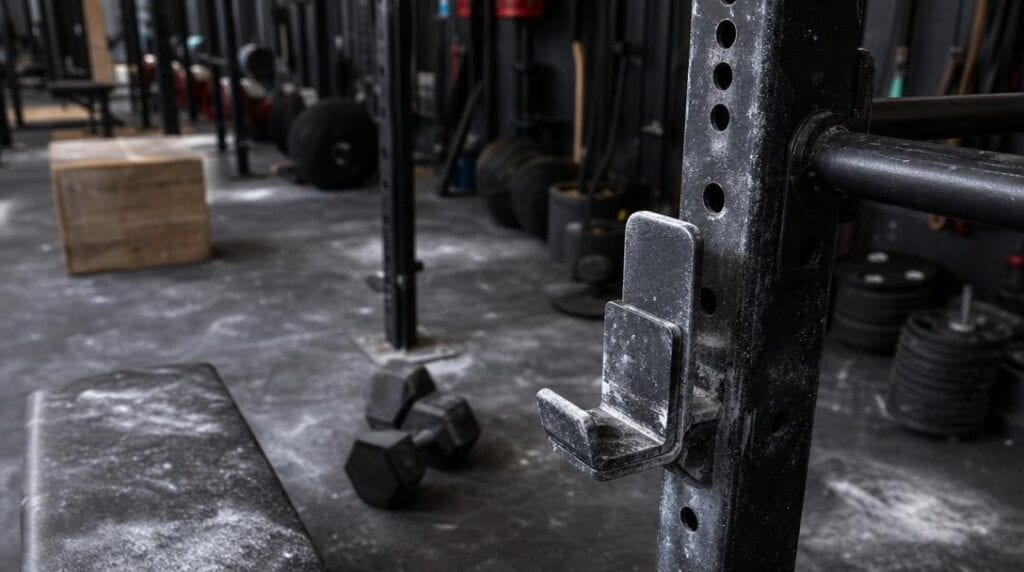
Chalk doesn’t stay where you put it. Every clap of loaded hands sends a fine cloud across the floor, onto the rig, and up toward the rafters. By the time you notice the white film on a pull-up station or the grey tinge on a rower seat, it’s already settled into every surface in the building.
Sweeping chalk makes it worse. Dry brooms lift fine magnesium carbonate particles back into the air, where they drift and resettle on barbells, kettlebell handles, HVAC grilles, whatever is in range. We use HEPA-filter vacuuming first, on floors and around lifting platforms, before anything wet touches the surface. This pulls the particulate rather than scattering it.
From there, pull-up rigs, rig uprights, gymnastics rings, and rower handles all get a microfiber wet-wipe pass using a non-residue disinfectant safe for coated steel. These are the surfaces members grip repeatedly throughout class. Chalk buildup on them isn’t just cosmetic. It’s a hygiene issue.
The part most boxes don’t address is up high. Warehouse units in Bayers Lake Business Park and Burnside Industrial Park typically run 12 to 18 foot ceilings with exposed ductwork and light fixtures. Chalk dust gathers on all of it. We schedule periodic high-dusting of those surfaces using extension equipment so the buildup doesn’t cycle back down onto your floor and equipment every time the HVAC kicks on.
Used chalk waste, saturated wipe collections, and chalk-bucket contents fall under Halifax Regional Municipality commercial waste handling rules. We dispose of everything through scheduled pickup, not general trash.
Once the chalk is cleared, the floor itself needs attention. Rubber is more demanding than it looks.
Deep Cleaning Rubber Gym Flooring Without Damaging It
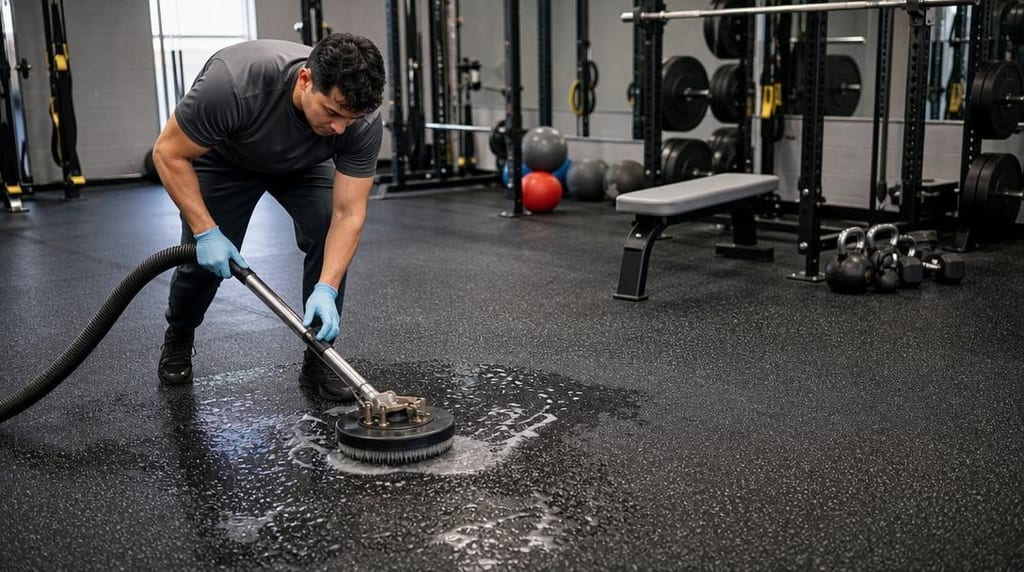
Yes, rubber gym flooring can be deep cleaned. But the chemistry has to be right, or you’ll do more damage than dirt ever would.
Most commercial floor cleaners are made for tile, vinyl, or concrete. Use them on vulcanized rubber tiles and you get swelling, surface breakdown, and discoloration that no amount of scrubbing will reverse. Solvent-based degreasers are the worst offender. High-pH strippers are a close second. Both attack the rubber compound itself, not just the grime sitting on top of it. The right approach is a pH-neutral cleaner at the right dilution, applied with equipment that works with the textured surface rather than against it.
That textured surface is exactly where Halifax boxes run into trouble in winter. Road salt and slush tracked in on members’ shoes settles into the tile grooves at entryways. Left alone, it leaves a white abrasive film. When chalk dust from the training floor mixes with that salt residue, you get a gritty paste that acts like sandpaper underfoot and speeds up tile wear. Tackling the entryway first, before any cleaning goes deeper into the floor, is the detail most in-house cleaning routines miss.
A properly set auto-scrubber outperforms mop-and-bucket on commercial rubber every time. Mops push dirty water across the surface and leave moisture sitting in the seams between tiles. An auto-scrubber applies solution, works the textured face, and pulls the water back in a single pass, which matters in a box where the next class rolls in within the hour. For tiles that have been worn down by years of salt and chalk, commercial floor refinishing can restore the surface before replacement becomes the only option.
If your rubber tiles are showing discoloration or the entryway has a gritty buildup that routine cleaning hasn’t shifted, it’s worth getting a professional assessment before the wear goes any deeper.
Floors are the foundation. But shared equipment is where members actually pick up bacteria, and that’s the next zone.
Equipment Sanitation: Barbells, Kettlebells, Rigs, and Rowers
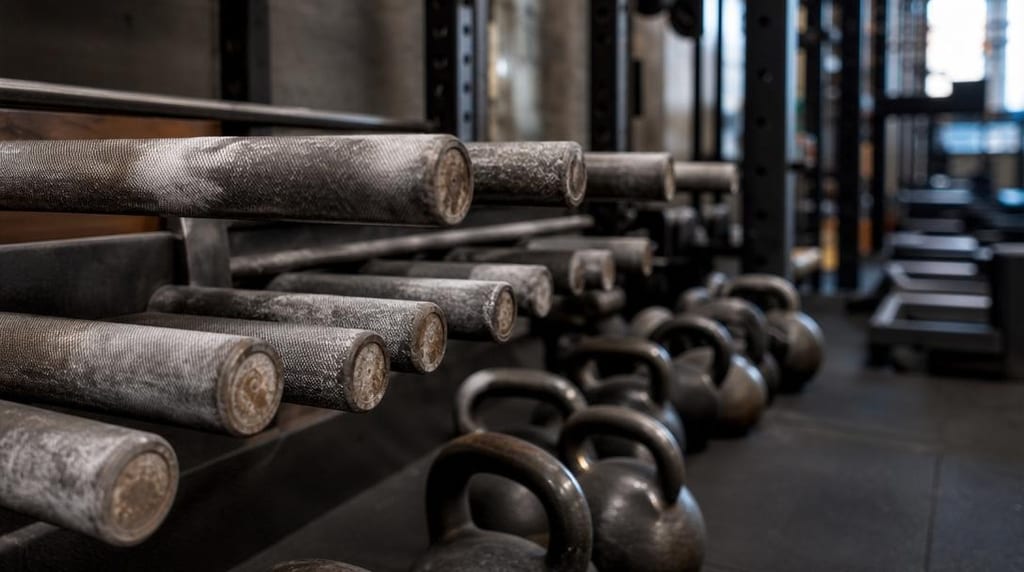
Barbells get gripped by twenty sets of hands on a busy Wednesday morning. By the time the last class clears out, the knurling is packed with chalk, skin cells, and sweat. That’s before you factor in what Halifax’s coastal air does overnight.
For boxes in Burnside or along the waterfront, salt air pushing through bay doors and loading-dock gaps is a real problem. It speeds up corrosion on knurling, rig hardware, and plate-loading pins faster than most owners expect. The fix isn’t just wiping equipment down. It’s using the right disinfectant. EPA-registered products rated safe for bare metal and foam grips protect the surface while killing pathogens. Dwell time matters here. Spraying and immediately wiping defeats the purpose. Most solid protocols hold contact for 60 to 90 seconds before wiping.
Kettlebells and medicine balls get full-surface wipe-downs on the same cycle. Wall balls take more attention than people assume. The fabric shell traps sweat and chalk and needs a separate brush-and-spray pass before disinfection.
Pull-up rig uprights collect chalk transfer from hands at every height. A dedicated dry brush runs the vertical sections before any wet product goes on, so disinfectant isn’t just spreading chalk residue around.
Rower seats and handles are their own protocol. Both are sweat-saturated after a class, and the seat rail collects grit from the floor on every slide. Handles get the same contact-time treatment as barbells. Seats and rails get wiped, then checked for any residue buildup in the rail groove.
Equipment and floors both get addressed. But the zone where bacterial load actually peaks in any CrossFit box is the sweat-heavy training floor itself. Halifax’s humidity keeps that environment active longer than most cleaners account for.
Sweat Zones, Turf Strips, and Halifax’s Humidity Problem

Halifax sits on the ocean. That matters more than most gym owners realize.
Coastal humidity keeps rubber flooring and foam equipment grips damp hours after a session ends. In an inland city, that moisture evaporates. In Halifax, it lingers, and bacteria thrive in it. That slow dry time is why the locker-room smell members complain about builds up faster here than it would in, say, a Calgary box running the same cleaning schedule. The protocol has to account for humidity, not just headcount.
Turf strips are the worst offender. The fibers trap sweat, chalk, and fine rubber particulate several layers deep. A spray-and-wipe approach never reaches it. Periodic commercial extraction cleaning with hot water is what actually clears the bacterial load out of a turf lane. Surface cleaning just moves it around and leaves the odor source intact underneath.
Sled-push strips and high-traffic landing zones carry the same problem. Any area where members are on their hands or lying on the floor between sets needs disinfection protocols matched to actual contact frequency, not a general mopping rotation.
Word travels fast in the Halifax fitness community. Kaos CrossFit, CrossFit Ironstone, CrossFit Basinview, the owners and coaches in this scene know each other, share vendors, and talk. A box that consistently smells clean and maintains its turf gets mentioned. One that doesn’t also gets mentioned.
If the odor has been building faster than it used to, or the turf hasn’t had an extraction clean in a few months, call (902) 440-8694 and we’ll put together a protocol that addresses the source rather than the surface.
Most box owners want to know, once they understand the protocol: how often does a professional deep clean actually need to happen?
How Often Should a Halifax CrossFit Box Be Professionally Cleaned?
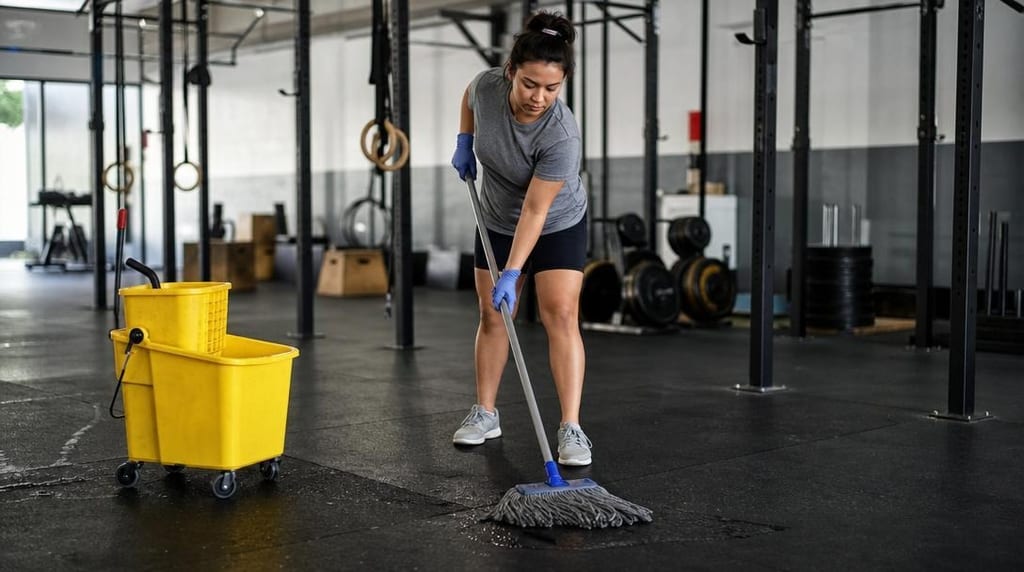
There’s no single right answer. But there’s a clear division of labor.
Daily tasks belong to coaches and staff: wiping down barbells and kettlebells between classes, spraying rower seats and pull-up rig handles, emptying chalk buckets, and keeping the restrooms from getting away from you during the morning rush. That baseline maintenance is necessary. It is not a substitute for professional cleaning.
A professional crew handles what daily wipe-downs can’t reach. For most Halifax boxes, that means two to three visits per week for thorough floor scrubbing and full surface disinfection, with enough attention to entry mats and rubber tile seams to stay ahead of the salt and slush that tracks in from October through March. Monthly, you want a high-dusting cycle on your rig, your exposed HVAC runs, and your light fixtures, where chalk settles and builds up in layers. Every quarter, turf strips need extraction cleaning and rubber floors benefit from a full restoration pass to pull out the grime that routine scrubbing doesn’t reach. Showers and member washrooms run on their own cycle, and washroom and shower facility cleaning is often bundled into the same visit.
Most Halifax boxes run classes from early morning through 7pm. C & C Commercial Cleaning Services Inc schedules around those windows, whether that’s the mid-day lull between sessions or after the last class clears out.
Cadence only matters if the team showing up actually understands what they’re cleaning and why.
Why Halifax CrossFit Box Owners Choose C & C Commercial Cleaning Services Inc
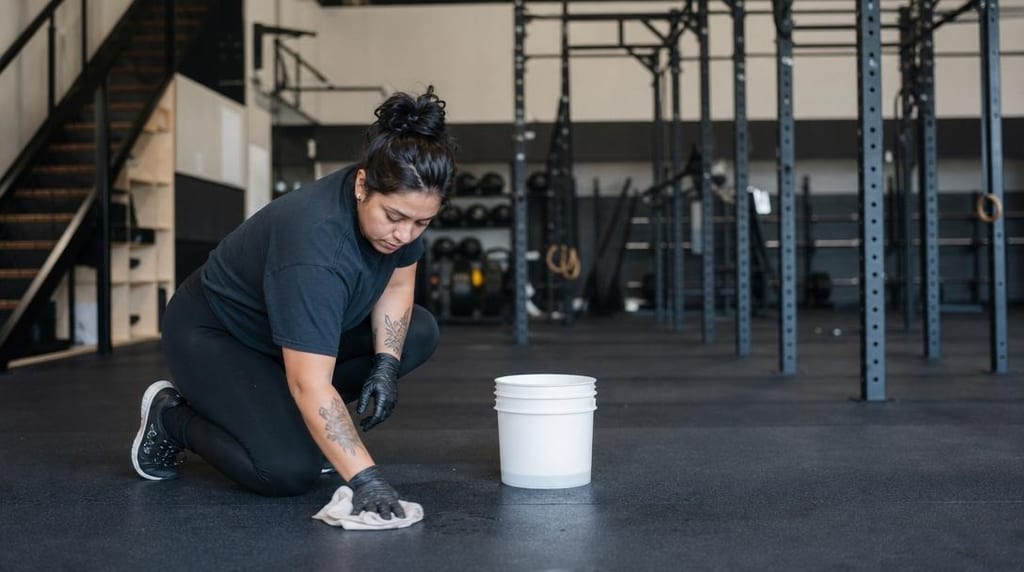
Box owners in Bayers Lake, Bedford, Burnside, Dartmouth, and downtown HRM have a short list of vendors they trust with their facility. Once word gets around that a cleaner doesn’t understand rubber floors or shows up at 6:30am during open gym, they’re gone. Reputation in this community moves fast.
C & C Commercial Cleaning Services Inc works specifically around your class schedule. Early morning opens, back-to-back evening classes, mid-day lulls, the crew fits into your operational window without disrupting members or coaches. Rubber-safe, EPA-registered chemistry only. Nothing on your flooring, foam grips, or equipment surfaces that hasn’t been checked for compatibility.
The crew is fully insured and operates under HRM commercial waste handling protocols. Chalk-bucket disposal and used wipe collection are handled correctly, not just bagged and left at the curb.
This is a Halifax business cleaning Halifax boxes. The coastal conditions, the salt-and-slush winters, the chalk-heavy air in Burnside warehouse units, none of it is new to us. Our work spans commercial cleaning services in Halifax across the fitness sector and beyond, including yoga studio cleaning and sports complex cleaning for facilities that share many of the same surface and humidity challenges.
The Halifax fitness community is small and word about a clean box travels. Call C & C Commercial Cleaning Services Inc at (902) 440-8694 and we’ll walk through your space before anyone picks up a mop. If calling isn’t convenient, fill out the contact form on our website and someone will follow up within one business day.